
Understanding Humanism
The scientific story of our origins
Humanists have a naturalistic understanding of the world around them and where we come from. They therefore believe that the scientific account provides the best explanation for our origins. Many religious people are also happy with what physics and biology have revealed. Unlike humanists, they might also seek some form of intention or design behind these laws of nature. Humanists don’t see the need or the evidence for this.
It is, however, rare for young children to encounter the scientific origin story. Evolution does not appear on the science curriculum until Year 6. The Big Bang doesn’t appear at all. That’s a real shame. We believe that it is vital that children get the opportunity to encounter the scientific explanation at least as early as they encounter the different religious creation stories, which often takes place in KS1. This provides them with the essential knowledge that there are alternative accounts for our origins to those provided by religion.
It’s also important because many children display teleological reasoning – they often believe everything happens for a purpose. Ask them why it rains and a common answer is ‘to help the flowers grow’. Religious creation stories often enforce that assumption, while the scientific story of our origins introduces a recognition that not everything has an intention behind it. The universe and human nature are the way they are because that is the way that physical and biological laws have operated on the world, not because of some grand design.
Of course, introducing the scientific story doesn’t require you to break out the physics and biology textbooks. You don’t need to be an expert in cosmology or genetics. Just because children (and many adults) won’t be able to grasp the finer details of the scientific explanation doesn’t mean that the key principles can’t be introduced in an age-appropriate way. We’ve listed a number of fantastic picture books below.
Finding wonder
‘The calcium in our teeth, the iron in our blood, the carbon in our apple pies were made in the interiors of collapsing stars. We are made of starstuff.’
Carl Sagan, astronomer and humanist
What is of paramount importance is that children are able to explore some of the wonder revealed by the scientific account of our origins. Physics has revealed how the atoms that make up our bodies were once formed deep inside the hearts of stars – we are all stardust. Biology has brought to light how we are related to every other living thing on the planet – we are all one extended family. We are part of something bigger than ourselves – the ongoing story of life on Earth.
While religious people might find wonder and meaning in the religious creation stories, humanists (and others) can do the same with the scientific account, drawing on it as a source of inspiration, meaning, and value in their lives.
- For humanists, our connection with the natural world and life in its many ‘brilliant and beautiful’ forms can provide a motivating reason to take care of it.
‘We are part of this natural universe and this natural world. We are part of the story of life on this planet. We can feel a real sense of belonging and connectedness in this story… We are connected with all other species; part of the huge, copiously branching tree of life. As conscious beings, we must surely endeavour to look after each other – and the planet.’
Alice Roberts, evolutionary biologist and Vice President of Humanists UK
- Many humanists see something joyous in the fact that such ‘simple’ ingredients can lead to such wondrous results.
‘Our entire bodies and brains are made of a few dollars’ worth of common elements… Assemble them all in the right proportion… and the result is our feeling, thinking, striving, imagining, creative selves. Such ordinary elements; such extraordinary results!’
James Hemming, President of Humanists UK (1977-1980)
- Humanists also sometimes point out how fortunate we are to exist. Our lives are the result of billions of earlier events – if any one of which had happened differently, we might never have been born. Life is therefore something to be celebrated. As are our many natural capacities. Humanists believe we should try to create the conditions for everyone to have the freedom and opportunity to use their capacities and potential to live their lives to the full.
- Humanists also find inspiration in how incredible it is that we are able to look back and tell this story: that we have evolved the capacity to ask and answer our questions about where we come from and to search for and find the evidence all around us (through astronomy, genetics, and palaeontology).
It’s important to acknowledge that neither humanists nor scientists claim to have all the answers. The story of our origins is not yet complete. However, the humanist approach is to keep looking for natural explanations for anything that we don’t yet fully understand. Children can be excited by the realisation that they might potentially one day help us to understand more about the story of where we come from.
Our animation narrated by Alice Roberts and accompanying teacher’s notes aims to bring some of the wonder of the scientific account to life in an accessible way for younger students.
Picture books
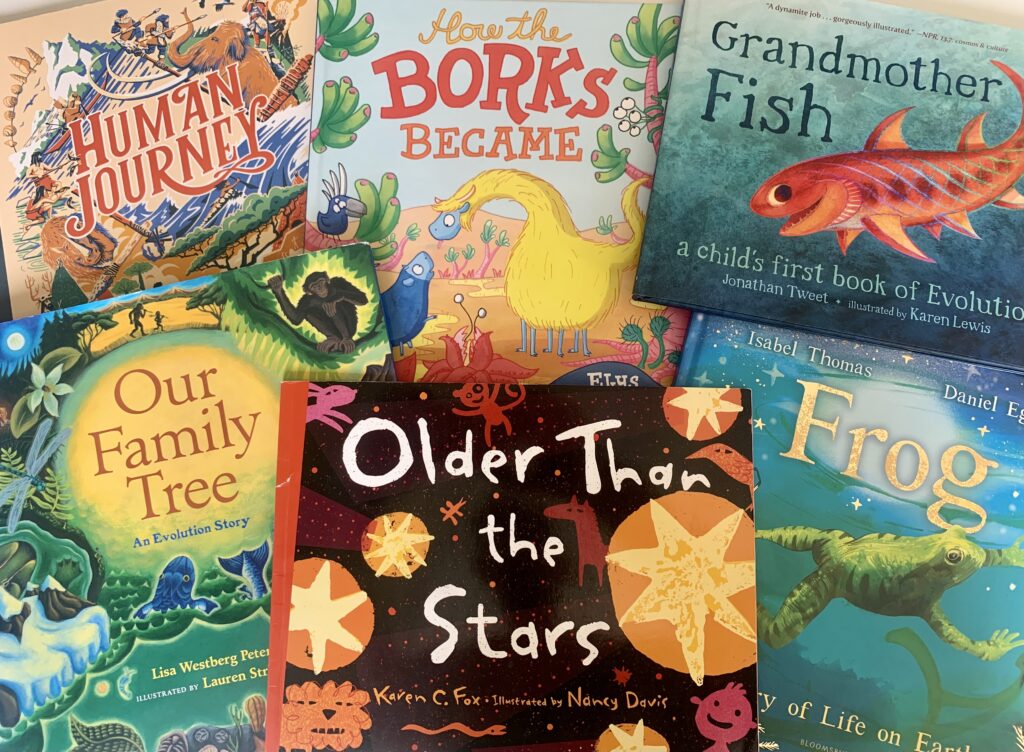
The following books are pitched at children from KS1 up and help provide an illuminating introduction to the scientific story of our origins in an accessible way.
- Older Than the Stars (Charlesbridge Publishing) by Karen C. Fox packs wonder into a poetic account of where we come from, from the Big Bang, through the formation of stars, planets, life, and us
- Our Family Tree (Houghton Mifflin) by Lisa Westberg Peters and Grandmother Fish (Feiwel & Friends) by Jonathan Tweet tell the story of our evolution and how what we are today links with our past
- For a more lighthearted story about how life adapts to its environment and changes over time, try How the Borks Became (Otter-Barry Books) by Jonathan Emmett
- Moth (Bloomsbury) by Isabel Thomas uses the story of the peppered moth to describe how one animal evolved to survive an environment transformed by human beings in more recent history, while Frog by the same author recounts the wider story of evolution
- For an account of Charles Darwin’s life and expedition on the Beagle, try What Mr Darwin Saw (Frances Lincoln Children’s Books) by Mick Manning (note: some of the pictures may not be suitable for younger children)
- Human Journey (Red Shed) by Alice Roberts describes the (comparatively) more recent story of our human journey out of Africa and across the globe.
- Finally, When Dad Showed Me the Universe (Gecko Press) by Ulf Stark describes the wonder of looking up into the cosmos (some of the stars we can see don’t even exist any more) while also recognising the need to be aware of what is right in front of us.
For more book recommendations see here.
If you enjoyed this, you might like our article on our favourite picture books about humanism.
Click here for more of our articles!