
Understanding Humanism
Darwin Day
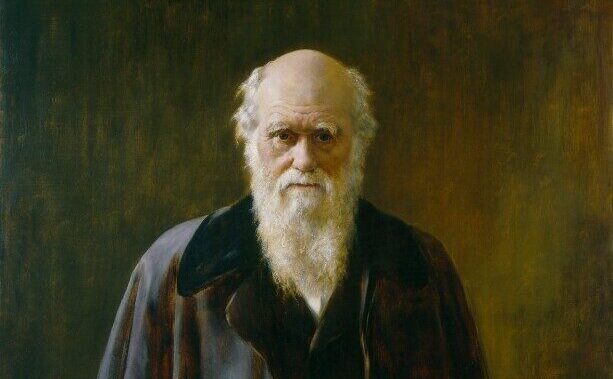
What is Darwin Day and why might humanists celebrate it?
Darwin Day is celebrated on 12 February, the anniversary of Charles Darwin’s birth. Many humanist organisations around the world celebrate it as an opportunity to raise awareness of Darwin’s significant achievements in science that transformed our understanding of human beings and our relationship to the rest of the natural world. Every year, for example, Humanists UK organises its annual Darwin Day Lecture.
Few scientists have had more of an impact on our scientific understanding, but what is it about Darwin that might particularly appeal to humanists? For many, it’s about what Darwin’s discoveries tell us about who we are, where we come from, and how we stand in relation to the rest of the living world. But there are also lessons to be found that may influence how a humanist might choose to live. Darwin’s ideas raise questions that can be explored not just in the science classroom, but in the broader curriculum, particularly in the study of worldviews and what motivates people to live the way they do.
What did Darwin believe?
Let’s begin by investigating what we know about Darwin’s own worldview. Darwin’s views have been a source of debate, but his own autobiography makes clear his rejection of many religious beliefs. Much of this was not to come to light until many years after his death. His account of his life initially suffered a great many redactions by people disturbed by what he wrote (including his son, Francis) partly as they wanted to protect Darwin’s reputation. His autobiography wasn’t released in its entirety until 1958 by his granddaughter Nora Barlow.
As a younger man, Darwin was undoubtedly religious, studying Divinity at Cambridge with the intention of becoming a clergyman. However, a life of science would ultimately lead him away from the church.
In his autobiography, he revealed that, even at the time, he found much of his study of religion difficult to understand, later believing it ‘in fact unintelligible’. Darwin described the Old Testament as a ‘manifestly false history of the world’ and while he found beauty in the morality of the New Testament, he rejected its miracles and historical accuracy. Any value it had, he felt, lay in its metaphorical interpretation.
On his religious beliefs he wrote: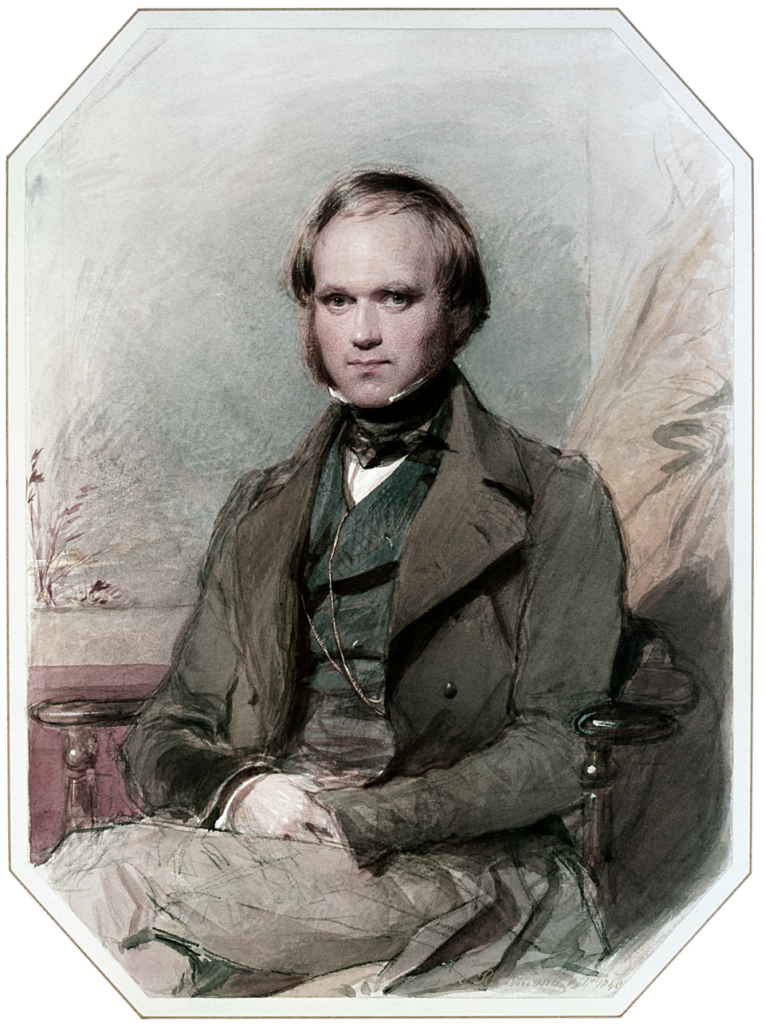
‘I found it more and more difficult, with free scope given to my imagination, to invent evidence which would suffice to convince me. Thus disbelief crept over me at a very slow rate, but was at last complete. The rate was so slow that I felt no distress, and have never since doubted even for a single second that my conclusion was correct.’
The Autobiography of Charles Darwin
His scientific exploration led him to recognise the problem of suffering, witnessing the relentless cruelty present in the natural world (including the death of his own 10-year-old daughter):
‘I cannot persuade myself that a beneficent and omnipotent God would have designedly created Ichneumonidae [parasitic wasps] with the express intention of their feeding within the living bodies of Caterpillars.’
From The Life and Letters of Charles Darwin
His theory of evolution also led inevitably to his rejection of the argument from design. Even what he felt was perhaps the strongest argument for the existence of some divine being left him unconvinced:
‘The mystery of the beginning of all things is insoluble by us; and I for one must be content to remain an Agnostic.’
The Autobiography of Charles Darwin
Some have claimed that he had a deathbed conversion, but this was strongly rejected by his family who were present during his final moments.
While he was alive, Darwin was rarely open about his views on religion (his father had advised him to ‘conceal carefully his doubts’). However, Darwin also believed his role was not to seek to change other people’s religious beliefs through his being vocal about his own. His ambition was to enlighten them with science. In 1880, he wrote to Edward Aveling that:
‘Though I am a strong advocate for free thought on all subjects… it appears to me (whether rightly or wrongly) that direct arguments against christianity & theism produce hardly any effect on the public; & freedom of thought is best promoted by the gradual illumination of men’s minds, which follow[s] from the advance of science.’
What is important is that Darwin’s rejection of religion did not lead him to reject morality or the possibility of living a meaningful life. As we’ll see, he held very humanist beliefs about our responsibilities to each other and where wonder could be found in our time on Earth.
What can we learn from Darwin’s ideas?
It is not Darwin’s (absence of) religious beliefs that have earned him praise from humanists Primarily he is held in such high regard by both humanists and non-humanists for his work to explain the origins and evolution of life on Earth. Few scientists have done more to better our understanding of ourselves and the flora and fauna with which we share the planet.
However, humanists find other sources of inspiration in what Darwin’s work reveals. His discoveries can help us to find answers to questions about how we might think about knowledge, meaning, and ethics. Some people have drawn negative (and often mistaken) conclusions from Darwin’s ideas, for example believing human beings are no longer special, that we are unavoidably selfish, that we are all trapped in a battle for survival and only the strongest will survive, or even that we should seek to engineer future human evolution through eugenics (often at the expense of the least privileged in society). However, it is also possible to draw more positive conclusions, and it is these that many humanists (and others) might draw on as sources of inspiration, meaning, and value in their lives.
Knowledge and belief
Before Darwin, many people believed the existence of a divine creator was necessary to explain the complexity of the living world around us. For many non-religious people, Darwin’s work can teach us that we should be wary of turning to non-natural explanations for those phenomena we cannot yet explain. This can be a source of motivation to humanists – we should not give up looking for natural explanations. They may speak of the need for rational patience. Humanists also often find wonder in how incredible it is that we have evolved the ability to ask and answer our questions about where we come from. There are, of course, still many questions to which we do not have complete answers. It may be the children in our classrooms today who will one day help us to understand more about the story of where we come from and the universe in which we live.
Our modern scientific understanding of life on Earth reveals that for many millions of years, and long before human beings even existed, animals have suffered in the fight for survival. This makes it difficult for humanists (and many people) to believe in the existence of a benevolent god or that suffering can be explained through some benefit to human beings – non-human suffering makes many theodicies (attempts to resolve the problem of suffering) difficult to accept. Suffering is simply a natural part of the biological world. That can be a motivating force for humanists to take action to minimise and alleviate suffering as best we can in the one life they believe we have.
‘That there is much suffering in the world no one disputes. Some have attempted to explain this in reference to man by imagining that it serves for his moral improvement. But the number of men in the world is as nothing compared with that of all other sentient beings, and these often suffer greatly without any moral improvement. A being so powerful and so full of knowledge as a God who could create the universe, is to our finite minds omnipotent and omniscient, and it revolts our understanding to suppose that his benevolence is not unbounded, for what advantage can there be in the sufferings of millions of the lower animals throughout almost endless time? This very old argument from the existence of suffering against the existence of an intelligent first cause seems to me a strong one; whereas, as just remarked, the presence of much suffering agrees well with the view that all organic beings have been developed through variation and natural selection.’
The Autobiography of Charles Darwin
Morality
Darwin’s theory of evolution by natural selection helps to explain how our moral instincts, such as empathy, compassion, and reciprocity, evolved naturally through our nature as social animals who have long lived together in groups. Collaboration has often been in our own interests, leading to natural tendencies to find ways to live well together. This does not mean that human beings are good all the time, but it helps to explain where our moral capacities come from. They are part of our human nature.
Biology and genetics post-Darwin has made clear that human beings are all one species. Many humanists argue that, when it comes to how we treat each other, we should first remember that we are all human, rather than dividing ourselves up into different races and creeds. When we focus on what we share, it can help us to recognise the error of prejudice and discrimination towards those who are different from us.
‘The social instincts acquired by man will from the first have given to him some wish to aid his fellows, some feeling of sympathy… As man advances in civilization, and small tribes are united into larger communities, the simplest reason would tell each individual that he ought to extend his social instincts and sympathies to all members of the same nation, though personally unknown to him. This point being once reached, there is only an artificial barrier to prevent his sympathies extending to the men of all nations and races.’
Charles Darwin, The Descent of Man
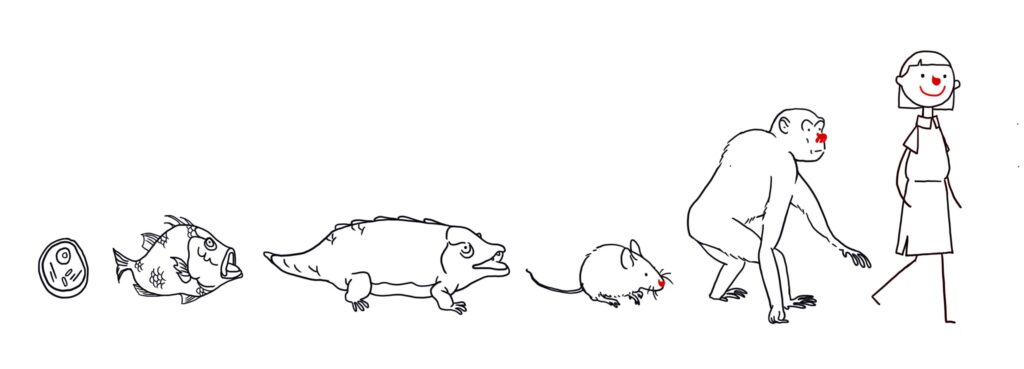
Evolution also teaches us that all life is part of one extended family. We are connected to every other living thing on the planet (we all share a common ancestor). We have learned the ways that other animals are similar to us, particularly in their capacity to suffer. We therefore have good reason to extend our warmth and kindness beyond our own species. Humanists can recognise that we are part of something bigger than ourselves – the ongoing story of life on our planet. As of yet, we are not aware of life’s existence elsewhere in the universe. Our dependency and connection with the natural world, as well as the joy we can find in life’s many brilliant and beautiful forms, can provide a motivating reason to take care of it.
Meaning and happiness
Recognising our human nature as creatures evolved to survive can help us to see why we and others may sometimes not act in virtuous ways. We have evolved both positive and negative instincts, propensities, and behaviours. That does not mean we should not aspire to be better or encourage others to be so, but it can help us seek understanding rather than immediately turning to guilt or rage when we or others cause harm.
Darwin’s theory of evolution reveals that human beings were not designed for some particular purpose. That can inspire a recognition that we have the freedom and responsibility to choose our own goals and aspirations in life. Such personal autonomy is of great importance to humanists in leading a personally meaningful life.
The probability of our existence – everything happening exactly as it did to lead to us – is tiny. Our lives are the result of billions of earlier events, any one of which had happened differently and we would never have been born. Every single one of our billions of ancestors had to survive long enough to reproduce. This can help us to see how fortunate we are to be alive. Life is therefore something that can be celebrated.
As can our many natural capacities. Evolution has given us the capacity to solve problems, to plan for the future, to reason, to create, to love. Humanists believe we can and should use these naturally evolved capacities to try to lead good and happy lives, and support other people to do the same. A common humanist ambition is to help create the conditions for everyone to have the freedom and opportunity to use those capacities and potential to the full.
The fact that nature is capable of producing such astonishing variety, beauty, and capability from such simple beginnings can be a source of wonder and amazement.
‘There is grandeur in this view of life, with its several powers, having been originally breathed into a few forms or into one; and that, whilst this planet has gone cycling on according to the fixed law of gravity, from so simple a beginning endless forms most beautiful and most wonderful have been, and are being, evolved.’
Charles Darwin, On the Origin of Species
These lessons illustrate one possible way that humanists can connect their scientific approach to understanding the world with their answers to questions about how we should live. There is no guarantee that what Darwin’s discoveries reveal about human nature will lead to positive outcomes – no logical necessity leading from them to a humanist approach to life. However, for humanists, a recognition of our nature as evolved creatures has the potential to support our wellbeing, can give us reason to celebrate, and can back up arguments that might lead to a fairer and kinder world.
Darwin Day in schools
Darwin Day presents a fantastic opportunity for schools to explore Darwin’s life and work, in particular the theory of evolution by natural selection. However, it’s also an ideal moment to introduce students to what it means to have a humanist approach to life.
Teachers can invite in a humanist school speaker to deliver a classroom session or whole-school assembly and answer students’ questions about Darwin and humanism. They can also find resources in the human beings area of the Understanding Humanism website, including our Where do we come from? animation for primary schools and Lessons from Darwin resource for secondary. We also recommend several picture books on the evolution of life on Earth.
With younger students you could explore Darwin’s love of nature: from his experiences on the HMS Beagle exploring the flora and fauna of South America to the fact he took nature walks in his garden every day. This could open up an exploration of the wonder humanists find in the natural world and their belief that science provides the best way to understand it.
In the secondary school classroom, the following questions can provide a stimulus to deeper discussions around Darwin and humanist beliefs and values:
- Does Darwin’s theory of evolution by natural selection lead to a diminishing of human beings or to potentially dangerous outcomes? How might a humanist respond to these concerns?
- What does Darwin’s discovery say about how we should tackle those questions we still do not have answers to? Is it best to avoid jumping to non-natural conclusions if we can’t yet explain something?
- How might Darwin’s discoveries be used in responses to the argument from design?
- Does the existence of widespread suffering long before humans even existed make it harder to believe in a benevolent god or that suffering is all for some purpose?
- How might those who accept the scientific story of our evolution explain where our moral instincts, including altruistic behaviour, come from?
- Does recognising we are all one extended family help us to see why we should widen our moral circle beyond our immediate family and friends? Can recognising our connections and what we share motivate us to take care of non-human animals?
- Can what Darwin revealed give us a sense of being part of something bigger than ourselves?
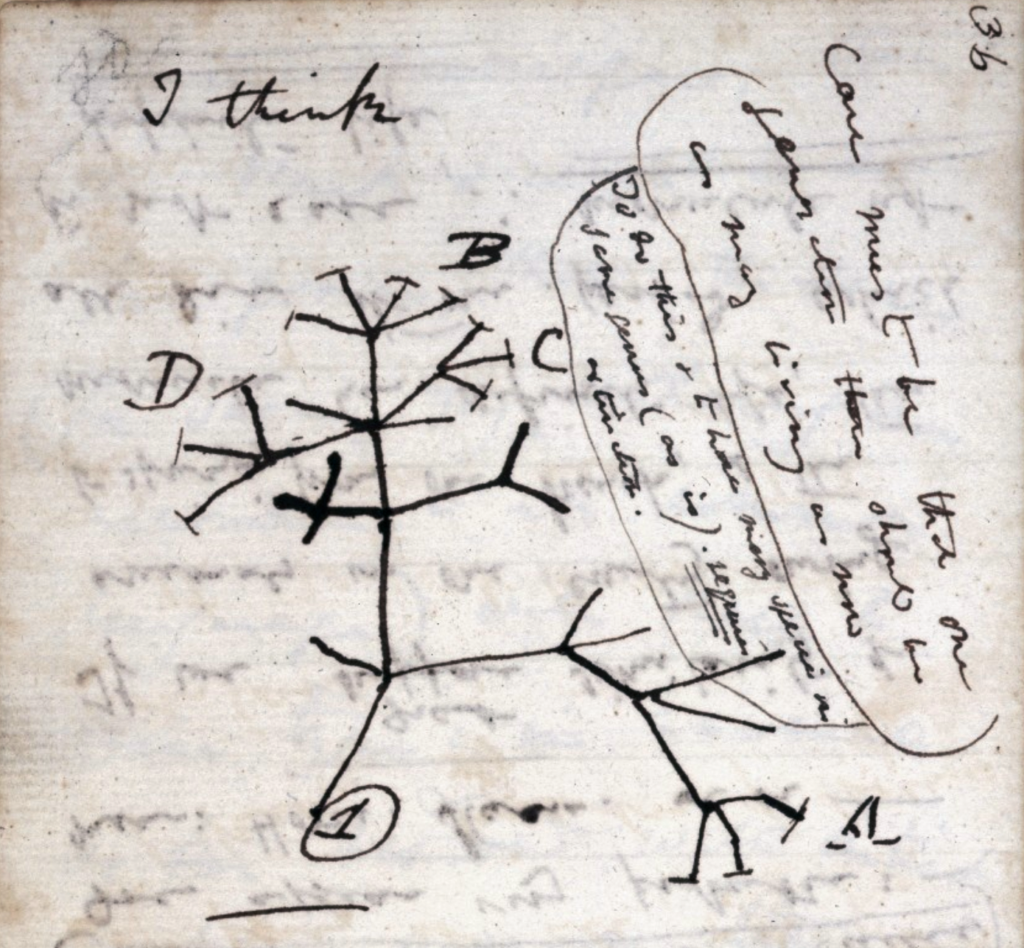
- If Darwin revealed that human beings are just one more branch on the tree of life, does that mean there is nothing special about human beings?
- Is a life without an ultimate cosmic purpose devoid of any meaning, or is it more important that we are able to choose what makes our own lives personally meaningful?
- How might the microscopic probability of everything coming together as it did to lead to our individual existence affect the way we see or value our lives?
- Can wonder be found in a scientific understanding of where we come from?
- Do you think that the knowledge that we are evolved creatures is more likely to have positive or negative consequences on how we live?
For more on Charles Darwin’s life and legacy see Humanist Heritage
Click here for more of our articles!