
Understanding Humanism
Assisted dying: a humanist perspective
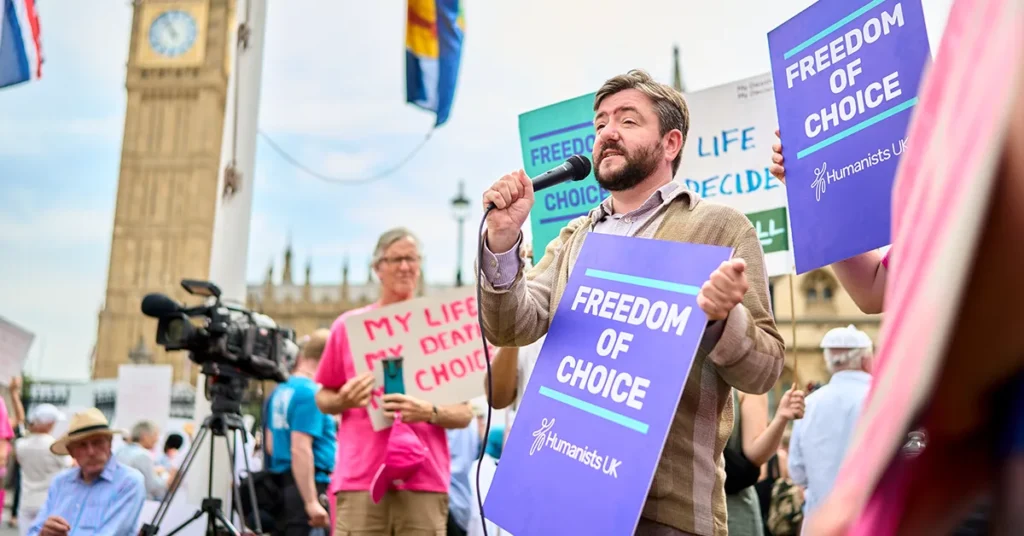
 With assisted dying prominent in the news recently and the Terminally Ill Adults (End of Life) Bill passing its Third Reading in the House of Commons it seemed like a good time to provide a humanist perspective on the issue. The below article by Richard Norman, Emeritus Professor of Moral Philosophy at the University of Kent and Patron of Humanists UK, illustrates a humanist approach to the question of whether assisted dying should be permitted.
–—————
A good example of how to think about a contested moral issue is the question of assisted dying. Should we change the law to make it permissible to meet the request of someone who is terminally ill, suffering unbearable pain, and asks for help to end their life?
If someone is suffering terribly, and you are in a position to help to relieve their suffering, that is a good reason to do so. Our empathy for the person leads us to feel compassion, and reason tells us that the compassionate response is, other things being equal, the right thing to do. This, then, is in principle a reason for changing the law. It is better that the law should enable us to do what is right rather than prevent us from doing it. The question is then whether this reason is outweighed by other considerations. In this respect our example is typical of many moral dilemmas: it’s not enough just to produce reasons for or against. To arrive at a rational decision we also have to weigh the competing reasons against one another.
Opponents, then, might say that the case for compassion is outweighed by the value of life. A fundamental moral principle, they might say, is that it is wrong to end the life of another person. However much we might want to end someone’s suffering, we cannot do so by performing a deeply wrong action. To assess this argument, then, we need to look carefully at what we mean by the value of life.
The idea is sometimes given a specifically religious formulation: life is a gift from god and as such it is not for us to dispose of. I will not examine the ‘gift’ analogy here (is it really always wrong to dispose of something you have been given?) but will simply emphasise that, even if a religious person is persuaded by it, it is a reason only for someone who accepts this specific religious belief. A change in the law would not compel such a person to help someone to die. And the law itself should reflect not contentious beliefs but broadly shared human values.
We therefore need to think about exactly what we mean by the value of life as a shared core value. What we value is not ‘life’ in the abstract. What we mean, I think, is that we must respect the life of each individual human being. Normally, their life is deeply precious to them, it is fundamental to all their hopes and aspirations and all the things they care about, and to deprive someone of their life is to do them a terrible wrong.
If that is the right way to understand the value of life, then we can see that the case of assisted dying is exceptional. In such a case, the person whose life is in question feels that their life has come to its proper end, and their one remaining wish is to be helped to die peacefully. If that wish is genuinely theirs, if it is their heartfelt and deeply considered choice – rather than the momentary expression of unbearable pain – then respect for that person’s life may no longer be something to override our compassion for them. It has to mean respect for the person’s autonomy, and as such it now becomes part of the reason to help them.
The two arguments so far are reasons in principle. Our task is to understand clearly what the relevant principles are, and in that way to decide whether one outweighs the other. We now need to make an important distinction between arguments in principle and arguments in practice. The so-called ‘slippery slope’ objection to legalising assisted dying is an objection in practice. Helping someone to die might sometimes be acceptable in principle, it may be said, but if we change the law it will in practice be abused, it will lead to pressure being put on people against their real wishes, and it will make sick or disabled people feel vulnerable.
Will it? This question is crucially different from the previous ones. It is a question about the likely consequences of changing the law. Here we need evidence. We need to look at the facts – at what has happened in other jurisdictions where assisted dying has been legalised, and at whether proposed legislation draws a clear line with reliable safeguards to prevent misuse of the law. That is the rational way to decide.
- Classroom resources featuring more humanist perspectives on assisted dying and other areas of ethical debate can be found in our Humanist Perspectives area.
- For more on the history of humanist campaigning in this area, see Humanist Heritage.
- This article comes from our free online course Introducing humanism: non-religious approaches to life.
Click here for more of our articles!