
Understanding Humanism
Can you be religious and humanist?
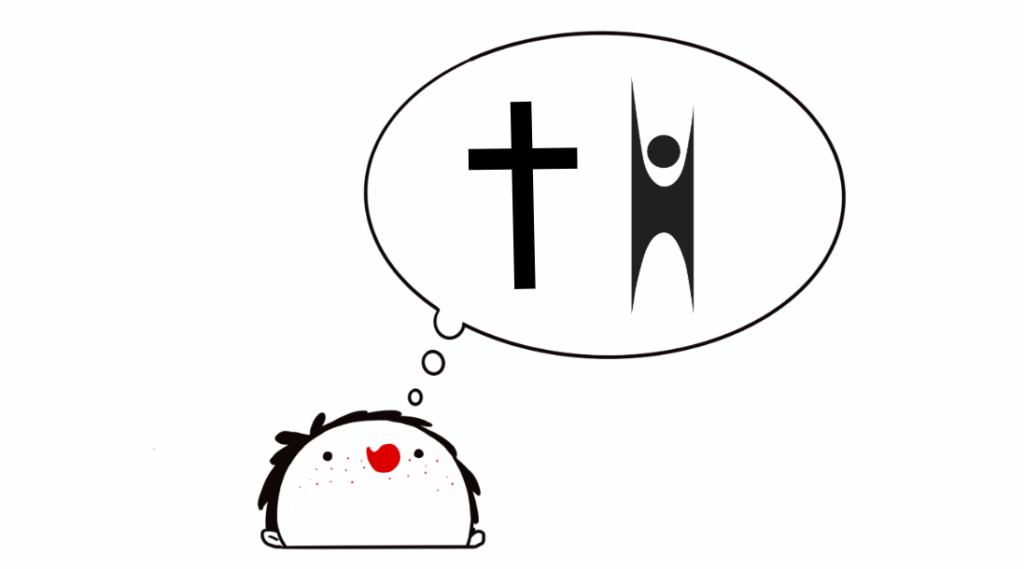
This question is one we touched on in our article on the history of the word ‘humanism’ but it probably warrants a little more exploration.
The short answer to whether you can be religious and humanist is that it depends upon what you mean by the words ‘religious’ and ‘humanist’. If ‘humanist’ is being applied in its earlier Renaissance sense to describe a student of the humanities, then there is no difficulty in also being religious. However, what about when ‘humanism’ is used in its modern sense to describe a non-religious approach to life? Many would argue such an understanding, by definition, precludes one from being religious and humanist. Nonetheless there are people who describe themselves as a Christian humanist or Jewish humanist. What might they mean?
There are different ways one might be described as religious. Let’s take the case of someone being Jewish. We might mean one of at least four things:
- that they believe in the God of Moses, God’s special regard for the Jewish people, and the wrongness of certain actions because of the prohibition against them by God – i.e. we mean that they have religious beliefs;
- that they attend a synagogue, and engage in Jewish rituals there and in the home – i.e. we mean that they participate in religious practices;
- that when asked if they are religious, they say they are, and they say that their religion is the Jewish religion – i.e. we mean they have a religious identity;
- that they say they are Jewish, but do not mean by this that they are in any way ‘religious’ – i.e. we mean they have a cultural identity associated with a particular religious heritage.*
Sometimes numbers 3 and 4 are consolidated and these categories are described as ‘The 3 ‘B’s’: belief, behaviour, and belonging. Some people are religious in all of these different dimensions; in other cases only in one or some.
We can recognise how those people who are religious in senses 2 or 4 above could be humanist. Their sense of belonging or their behaviour would not preclude them from holding a humanist worldview. Such people can be found across the world’s religions and it is important to recognise that among those people describing themselves as ‘religious’ on surveys and censuses, there are many who hold non-religious beliefs and might have a humanist approach to life:
‘For me, Jewishness, and I would say for an awful lot of Jews, is nothing to do with believing in God… For me, Jew is an identity. It’s an ethnic and cultural identity, which I feel very strongly… My Jewish identity is to do with food, and comedy, and family, and literature, and a way of being, and, incredibly importantly, anti-semitism.’
David Baddiel, Patron of Humanists UK
‘I consider myself a non-practicing Hindu… I consider myself a Hindu, by identity rather than belief system.’
Paul Sinha, Patron of Humanists UK
Category 1 is trickier. It would be difficult to hold particular religious beliefs and simultaneously hold humanist beliefs. Of course, we must always recognise that people’s beliefs can be messy and not everyone’s worldview is internally coherent.
There are, however, some who feel the need to qualify humanism (the non-religious worldview) by prefixing it with the adjective ‘secular’ to distinguish it from an alternative ‘religious humanism’ in which one can hold religious beliefs and describe oneself as a ‘humanist’. While many British humanists object to the use of this qualification, it is more popular in the United States.
This claim to there being a ‘religious humanism’ is perhaps most obviously visible in those who might describe themselves as a ‘Christian humanist’. Their ‘Christian humanism’, a twentieth century coinage, describes holding a human-centred ethics and the promotion of humanitarian principles (such as individual freedom and happiness) within a Christian framework. This co-opting of the more amenable aspects of humanism, has led other religious traditions to also claim a ‘humanism’ of their own. While such descriptions may be employed with quite innocent intentions, some have seen it as a deliberate attempt to muddy the waters, and even to spread the historically inaccurate message that humanism is merely an off-shoot from a broader religious tradition.
In response to these claims to the existence of a ‘religious humanism’, Chief Executive of Humanists UK Andrew Copson has said the following:
‘Language, of course, is mutable over time, but there are good reasons to try to retain coherence and integrity in the use of the nouns ‘humanist’ and ‘humanism’ unqualified. Subsequent to their earlier usage to describe an academic discipline or curriculum (whose followers, obviously, might well be religious), ‘humanism’ and ‘humanist’ have been used relatively consistently as describing an attitude that is at least quite separate from religion and that in many respects contrasts and conflicts with religion(s). Of course, many of the values associated with this humanism can be held and are held by people as part of a wider assortment of beliefs and values, some of which beliefs and values may be religious (people are complicated and inconsistent)… These vagaries of human behaviour and self‐description are a poor reason for dismembering such a useful single conceptual category as ‘humanism’ is in practice, especially when there are words more suitable to combine with the religious qualifiers that would lead to no such verbal confusion. In The Open Society and Its Enemies, Karl Popper used ‘humanitarianism’ for this purpose, urging co‐operation between ‘humanists’ and religious ‘humanitarians’. The use of ‘humanistic’ in front of the religious noun in question is also preferable (e.g. ‘humanistic Islam’ or ‘humanistic Judaism’). It performs the necessary modification but also conveys the accurate sense that what is primary is the religion at hand and that the qualification is secondary.’*
So, yes, it is possible to be considered both religious and humanist because of the variety of ways in which one might be religious. However, that should not draw us to conclude that there are two distinct forms of humanism, one religious and the other not.
There is, of course, one other way in which one might describe oneself as religious and humanist, and that is if one defines ‘religion’ as a category in a broad enough sense to include humanism. Whether that can be done is not without disagreement. We’ll take a closer look at that debate in our next article.
See also
- ‘Humanism’: a history of the word
- Is humanism a religion?
- What is humanism? by Andrew Copson (from The Wiley Blackwell Handbook of Humanism, edited by Andrew Copson and A C Grayling)
Click here for more of our articles!
*Andrew Copson, What is Humanism?, The Wiley Blackwell Handbook of Humanism